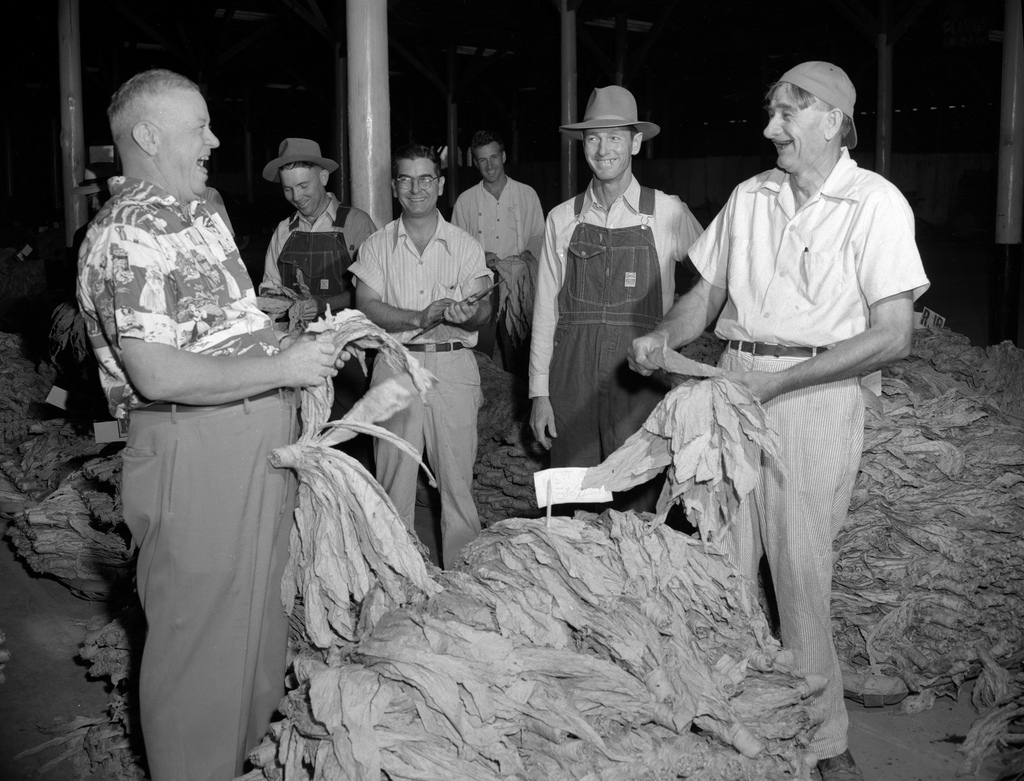
 Without a major river to provide transportation, Wilson County was sparsely populated in earlier times, first by a smattering of Tuscarora Indians and later by European settlers and African-American slaves. A railroad brought growth to the area after the Civil War but it was bright leaf tobacco that put Wilson County on the map. I remember seeing black and white photos like this one in our local paper each year, celebrating the annual tobacco auctions that brought millions of dollars to eastern North Carolina communities like Wilson. For a Chapel Hill girl who’d never touched a tobacco leaf, these pictures provided a glimpse into a world that seemed almost foreign even though it existed just miles from my own.
Today you can see reminders of those heady tobacco market times in Wilson’s downtown, a multi-block area that is surprisingly large for a town of 50,000. There are grand, historic buildings: the two-story, neo-classical edifice that was BB&T’s original corporate headquarters and the forlorn sight of what once had to be a bustling hotel that is now consigned to housing for the elderly. Wilson’s downtown may no longer be the centerpiece of a thriving tobacco market, but it still shows more signs of life than many towns of similar size. And when Vollis Simpson’s giant whirligigs are moved to town permanently, I expect there will be plenty more.
Several years ago a number of women from the Chapel Hill High class of 1971 reconnected through Facebook and a group of us formed a monthly book club. We weren’t necessarily friends as teenagers and may not have had a lot in common at the age of 15 but having been in the same place at the same age so many years ago provides us with a strong bond today. We remember getting out of school as third graders to hear President Kennedy speak at Kenan Stadium on University Day. Our first taste of pizza was at the Rathskeller in Chapel Hill’s Amber Alley. As eighth graders, we experienced culture shock when the schools were fully integrated and we all came together, black and white, for the first time. Our book club meetings are a fascinating and fun chance to share memories, many of them so different but always with that underlying thread of a common place and time (and we even manage to squeeze in book discussion too!).
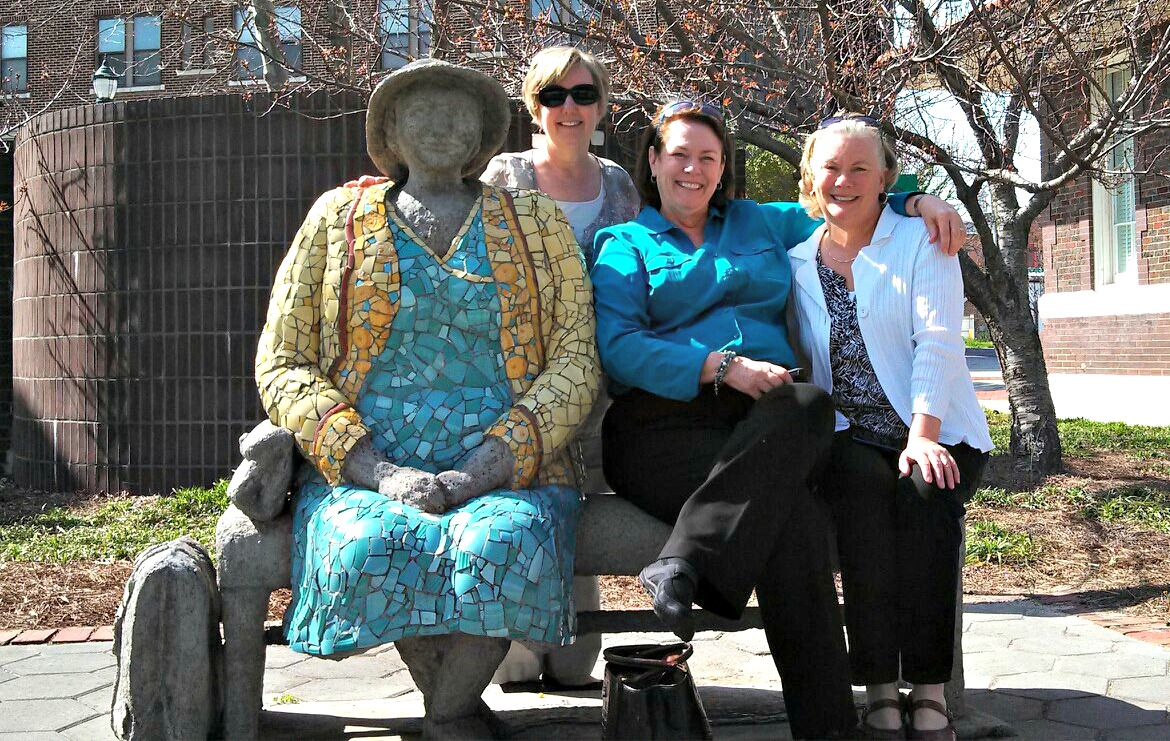
Our April book club meeting was hosted by classmate Beth Punte who’s made her home in Wilson for the past 25 years. After our meeting, Beth was gracious enough to show us around Wilson, ending at the train depot where Wilson’s modern history truly began. At the station, we were introduced to Rose Rail, who sits patiently waiting on a depot bench for her train to arrive. Although a few of Rose’s mosaic pieces have broken off and lie scattered on the sidewalk nearby, Rose maintains a stoic strength. Just as Wilson County has seen its share of hard times, you have a feeling Rose has as well and that, in spite of her broken parts, she endures. No wonder we were all eager to have our pictures taken with Rose. At the age of 60, we too have suffered breaks and blows but like Rose, and the eastern North Carolina county where she sits on her bench waiting, we are still here and still looking ahead to the next adventure.
April 7, 2013 County #12 – Wilson


Susan, thank you for writing such a nice blog post about Wilson County. It was my pleasure to help you discover a little bit of Wilson County.