My rational mind knows that September in North Carolina is still summertime. But when I see the smallest change in the color of the leaves and pumpkin spice products on sale everywhere, it’s hard not to convince myself that cooler, humidity-free days are ahead. With that in mind, I planned a mid-September road trip to Cabarrus, Union, and Anson counties, near the South Carolina line just east of Charlotte. What I didn’t know when I planned my trip was that it would be just days after the stunning murder of right-wing activist Charlie Kirk. With virulently anti-progressive sentiments running high in certain MAGA-heavy pockets of our state, I braced my left-wing self for provocation and was convinced by family members to temporarily remove the “Pro-America/Anti-Trump” sticker from the back of my car.
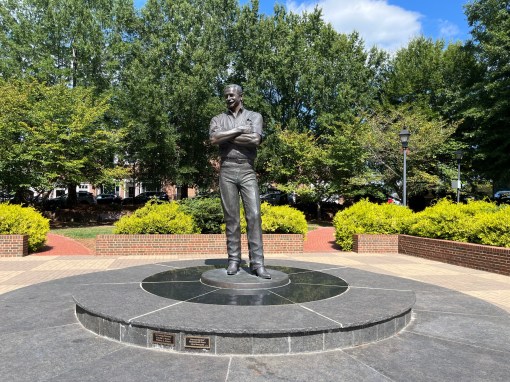
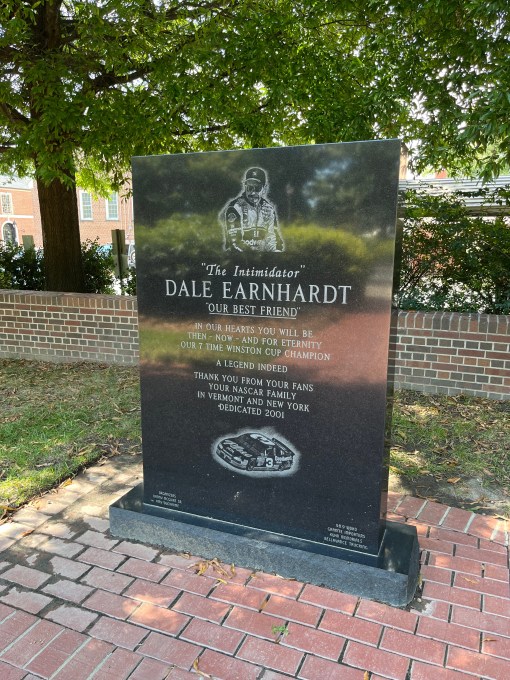
My drive to Kannapolis, a town that straddles Rowan and Cabarrus counties, was a pleasantly peaceful surprise with little evidence of venomous political signs. Originally a mill town housing Cannon Mills, the name Kannapolis derives from Cannon. When the mill shut down, the former owner purchased its property and created a research center on the site that has led to a thriving downtown. Close by the research center campus, I found the Dale Earnhardt Tribute Plaza, honoring the Kannapolis native and hometown hero who is one of NASCAR’s most legendary and colorful drivers. As someone who superstitiously ascribes significance to numbers, I appreciated the rampant symbolism in the park recognizing meaningful numbers associated with Earnhardt including his race car (3) and his Winston Cup Championships (7). In the picture above you can see the shrubs are planted in groups of three and the base of his statue is divided into seven sections.
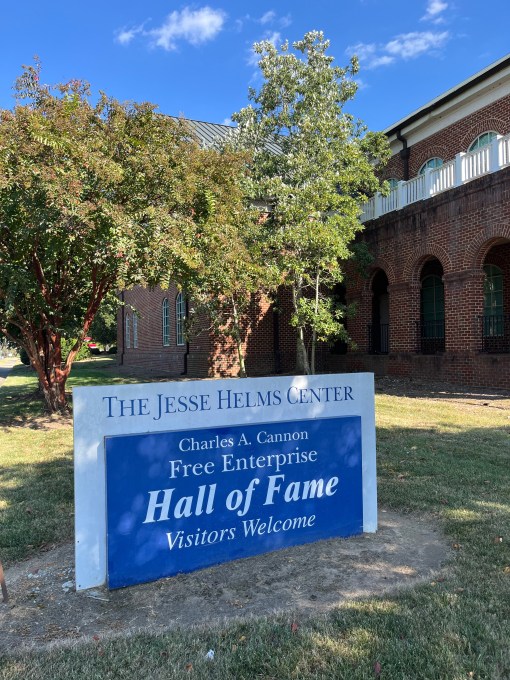
Next stop was Union County, home of The Jesse Helms Center, honoring the former North Carolina senator who was born and raised there. Helms is still reviled by many in my own hometown for his animosity towards the values we hold dear. Given my state of mind as I watched the sanctification of a slain podcaster while a right-wing grifter was running roughshod over our democracy, I wasn’t inclined to feel warmly towards the home county of the man who was the spiritual godfather of Charlie Kirk’s style of vitriol. Of course, I had to remind myself that every place is made up of all sorts of different people, all of us having something to offer to one another and the world. And after all, I did discover that Union County got its name as a compromise between Whigs and Democrats who each wanted to name the new county after one of their own! Still, I wasn’t in a compromising frame of mind, willing to stick around and seek out the good. I walked the grounds of the center that bears Jesse Helms name, took a picture, and kept on driving.
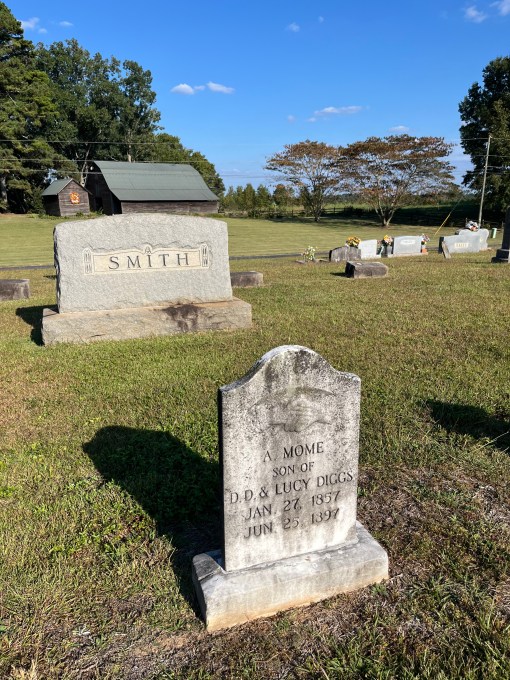
Just over the Union County line, I stopped at the Peachland Cemetery in Anson County, looking for the grave of Mome Diggs. Born in Anson County in 1857, Diggs led a life of crime, most notably as a member of the Jesse James gang. After far-flung escapades as an outlaw, Diggs returned home and before long shot and killed a man in Wadesboro. After his release from the state penitentiary, Diggs himself was shot and killed in nearby Union County and buried near his childhood home. I found this man whose life was marked by violence buried in a setting of peace and beauty.
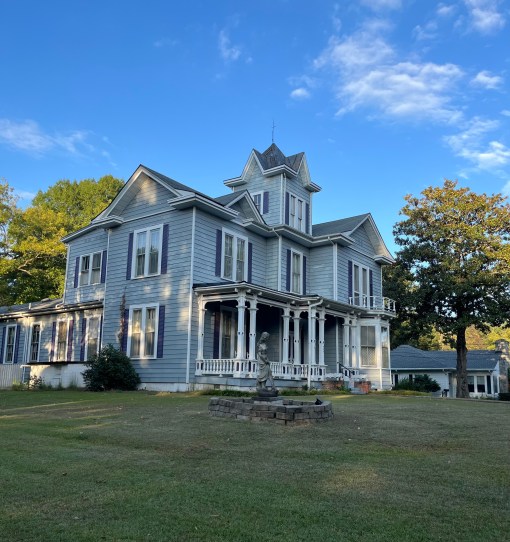
Wadesboro, NC is the hometown of an acquaintance of mine. It wasn’t until I arrived there that I discovered Wadesboro has a distinct Steel Magnolias vibe! My impressive bed and breakfast, pictured above, was just a few houses down the street from my friend’s equally grandiose childhood home. In spite of the Steel Magnolias feel of these stately residences, it was another major movie that had quite an impact in Anson County. Steven Spielberg’s The Color Purple was filmed in Anson and next-door Union County in the summer of 1985. Forty years later, there are still plenty of residents who recall it well, many of whom had bit parts in the classic, beloved film.
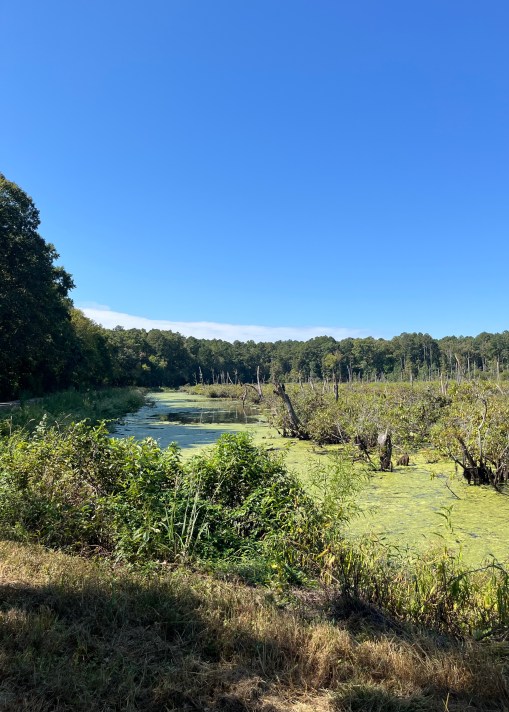
Before leaving Anson County for home, I took a morning walk through the Pee Dee National Wildlife Refuge. With only birds and wildlife for company, the tranquil surroundings were the perfect place to reflect on my trip. In the 1960s, North Carolina promoted tourism with a song called Variety Vacationland (“Wonderland of variety, coast to mountains it’s great to be, right here in North Car-o-li-na”). My trip was a reminder that the variety in our state doesn’t just apply to its natural beauty but to the cast of interesting characters who have called it home. From a beloved NASCAR driver known as The Intimidator to a small-town boy who rode with Jesse James and then on to another Jesse notorious for his politics, North Carolina has bred its share of singular individuals who help stitch the rich fabric of our state.
September 17 – 18, 2025 – Counties #73, 74, and 75 – Cabarrus, Union, and Anson
Leaving the beach on a beautiful, late-summer day, I took a circuitous route home (my favorite kind!), winding along backroads through four of North Carolina’s eastern counties.
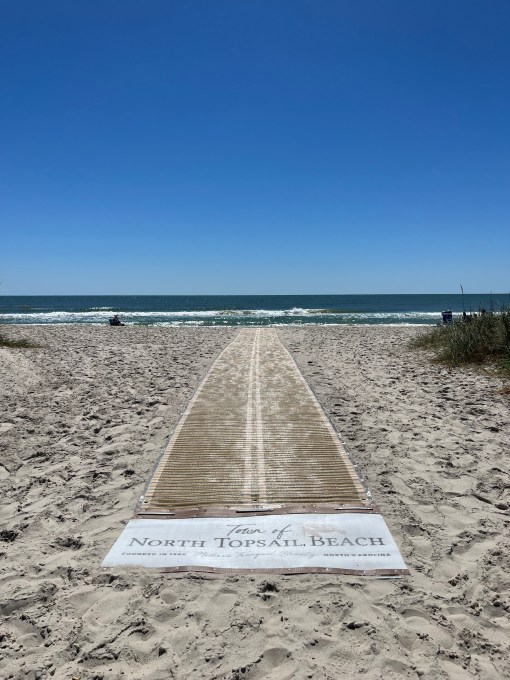
The most populated part of Onslow County is the Jacksonville area, home of the Camp Lejeune Marine Corps base. For me though, Onslow is important for its beaches. Our family spends a week on Topsail Island every summer (pronounced Top-sul here in North Carolina). Although we prefer the southern, Pender County end of the island, we’ve enjoyed several memorable beach weeks in Onslow County’s North Topsail.
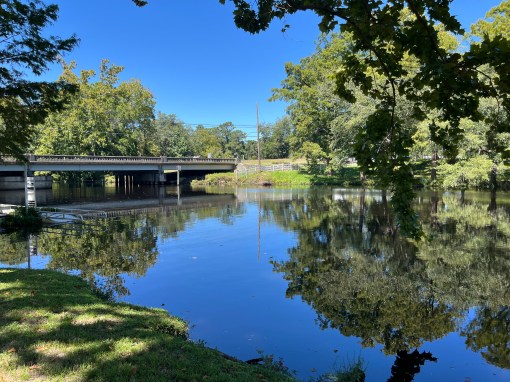
With a population of fewer than 10,000 people, Jones County boasts more natural beauty than human accomplishments and that’s not necessarily a bad thing. I took a break in Pollocksville to enjoy a view of the Trent River.
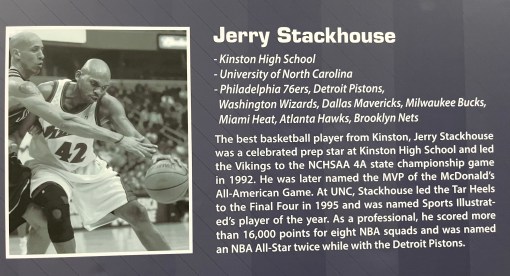
From Jones County, I headed northwest to Lenoir County and the town of Kinston, which holds a special place in my heart as the home of UNC basketball greats Jerry Stackhouse and Reggie Bullock. Carolina basketball looms so large in my world that I expected a little more recognition of these two than I found in Kinston. I was happy though to see a shoutout to Stackhouse in the Kinston-Lenoir County Sports Hall of Fame as Kinston’s best ever.
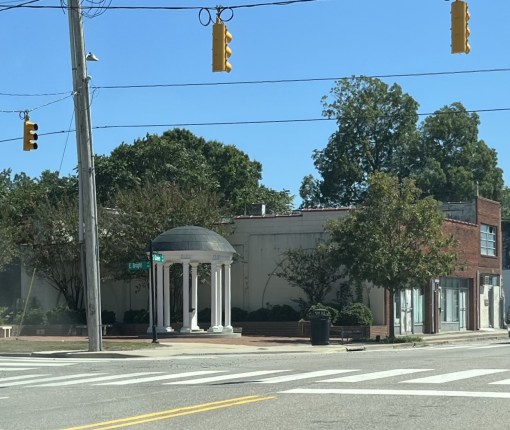
Driving through downtown Kinston on South Queen Street, I was taken aback to see an exact replica of the Old Well on the corner in front of me. The Old Well is an iconic symbol of UNC and of course I had to know why there was a copy of it in this particular spot! What I discovered is that Kinston has produced more than just UNC basketball greats. Harvey Beech was one of several trailblazing Black students who integrated the university in the early 1950s, gaining admission to the law school with the legal assistance of Thurgood Marshall. Beech went on to live a remarkable life in Kinston and was honored by the town with this symbol of the school he had to fight to attend. For a town of around 20,000 people, Kinston has produced a significant number of remarkable individuals.
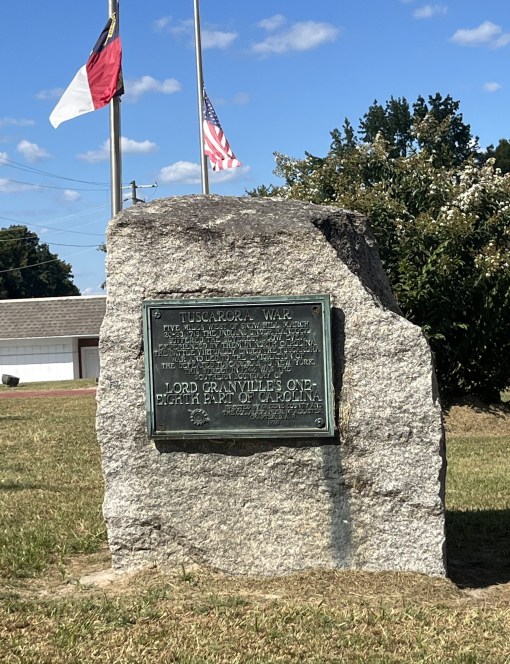
The last stop on my journey was Greene County. For centuries before the arrival of Europeans, this land was home to the Tuscarora. Today, on the courthouse lawn in Snow Hill, a stone marker commemorates a nearby battle that led to the death or capture of nearly 1,000 Tuscarora in 1773. This defeat ended a three-year war with colonists and drove the Tuscarora north from their homeland where they joined with the Iroquois League in present-day New York. (Flags in the picture are half-staff in honor of Michael Verardo, a US Army Afghanistan War veteran who advocated for wounded veterans and their families.)
Traveling country roads through this fascinating state of ours, there are constant reminders that, whenever and wherever human beings make their home, you will find evidence of violence, militarism, and discord that has touched even the most seemingly peaceful corner. Where we humans dwell, strife and beauty inevitably go hand in hand.
September 3, 2025 – Counties #69, 70, 71, and 72 – Onslow, Jones, Lenoir and Greene