Traveling the Tar Heel state, county by county
Monthly Archives: June 2012
Rediscovery
Back when I was a student at Chapel Hill High, my friends and I frequently skipped school. Chapel Hill was a small enough place then that we couldn’t risk staying in town and, unlike Ferris Bueller, we didn’t have a big city like Chicago nearby in which to lose ourselves. Instead, we spent those out-of-school days driving country roads near Chapel Hill. In our wanderings, we came upon several abandoned mill towns along the Haw River. Having read our fair share of Trixie Belden and Nancy Drew mysteries as kids, we never doubted that we had in fact discovered these towns and that no one else knew about them (sort of like Christopher Columbus “discovering” a world people had been living in for centuries).
One of those mill towns my high school friends and I stumbled upon was Saxapahaw, a community in southern Alamance County. Since my skipping school days, Saxapahaw has been most emphatically discovered. The old mill itself has been turned into condominiums, musical Saturday night gatherings are held there in the summer, and there’s even a general store where you can pick up both Slim Jims and cashew butter.
Interstate 40/85 slices horizontally through Alamance County. North of the highway you find the familiar outlet malls of Burlington and a conglomeration of commercial sprawl that could be Anywhere, USA. Even the attractive college town of Elon lacks a spirit of vibrancy.
South of the interstate though, Alamance County retains its soul. It’s hard to imagine anyone not being charmed by Saxapahaw. Other rural communities like Eli Whitney and Alamance are similarly situated among rolling green fields and the land almost pulsates with history. The village of Alamance may not have been incorporated until 1979 but it is a spot where Indians, Revolutionary War, and Civil War soldiers all once gathered.
On a particularly gorgeous day in June, driving the roads of Alamance County with my daughter was an ideal way to spend my birthday. Time has marched on for me and for Saxapahaw since those long ago high school days. The change is good.
June 14, 2012 – County #7 – Alamance
Montgomery and Moore
Yesterday I headed to Town Creek Indian Mound in Montgomery County with my long-time friend, Anne Geer (what a good feeling it is spending time with someone you’ve known since elementary school). I learned a lot at Town Creek about pre-1500 Native American culture and hope to learn more from a book Anne recommended to me, 1491. After leaving Town Creek, we found fresh peaches at a local Moore County farm Anne had heard about from a friend and rewarded ourselves with the special treat of homemade peach ice cream from a roadside stand.
Each time I travel to a county, I try to be open to whatever I may experience there. My goal isn’t to have a fabulous time on each visit but to experience that county for whatever it has to offer on a particular day. Still, as often as I tell myself that, I do harbor a desire to happen upon something unexpected as I’m traveling along. With today’s technology keeping the world abreast of everyone’s waking moment, it’s less and less likely that we might find surprises along the way but that doesn’t stop me from hoping.
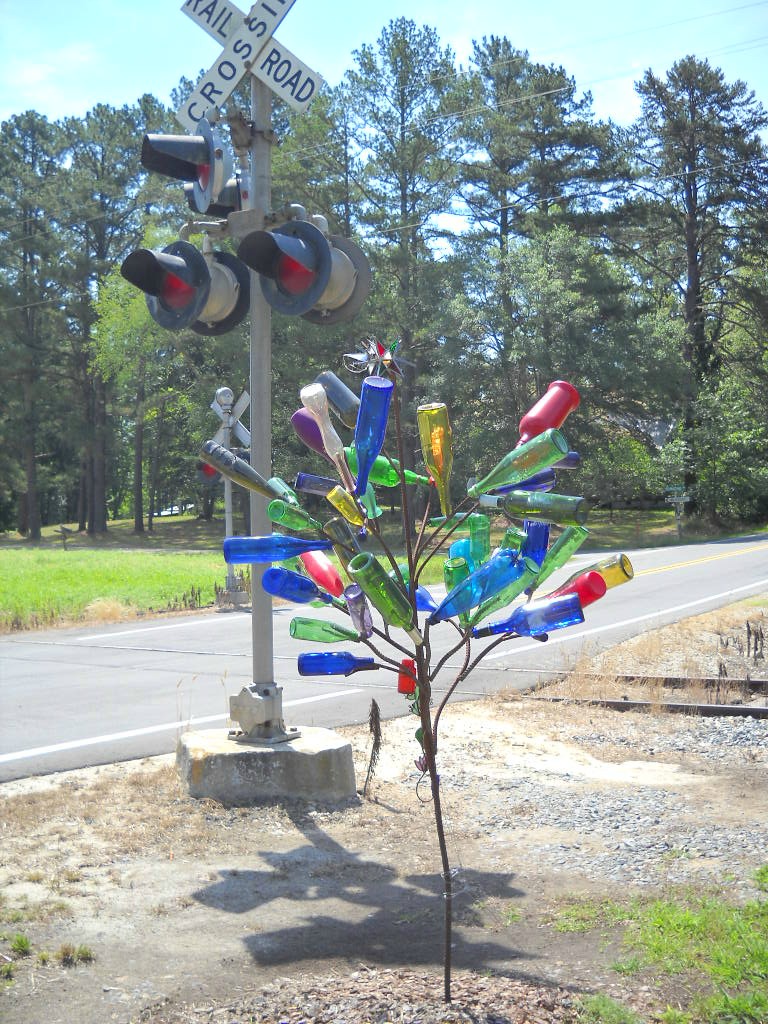
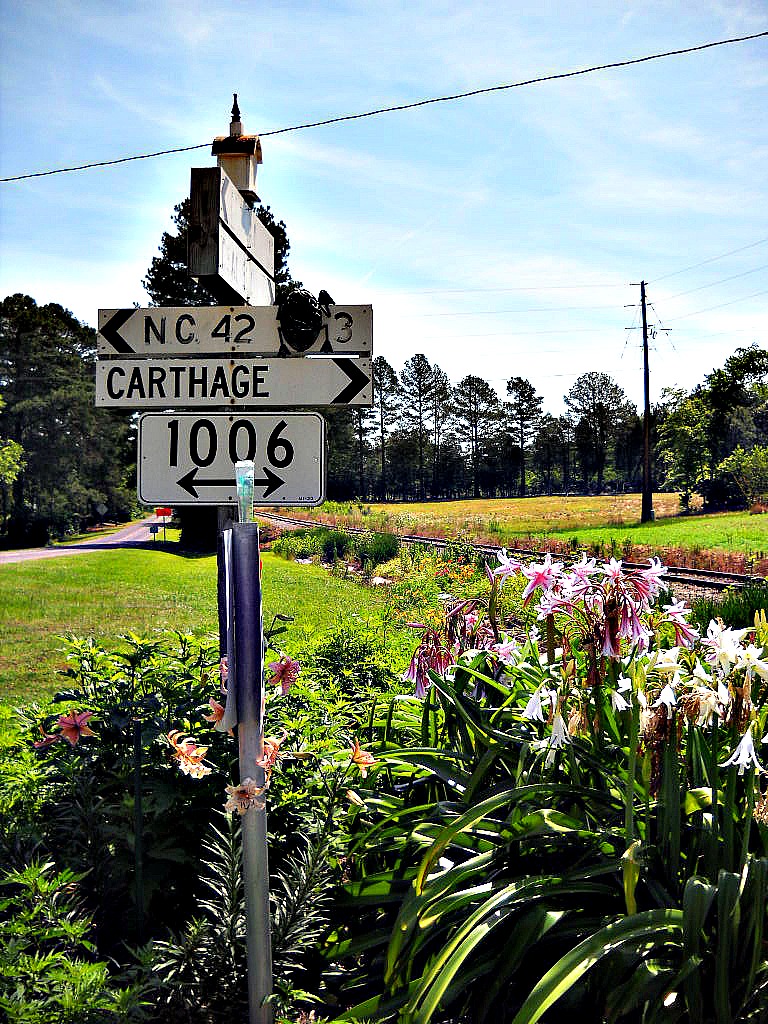
That’s why I was excited to experience just such an unexpected surprise when Anne and I came upon this whimsically decorated crossroads in rural Moore County. A two-story house stands on one corner with a couple of friendly dogs on the front porch. We could only guess that the owners of that home were responsible for the bottle tree, the plantings around road signs, and the decorations on the signs themselves. I would love to know more about the story behind it all but, regardless of what that story might be, the crossroads at Glendon was the highlight of a fun trip through the counties of Montgomery and Moore.
Counties #5 & 6 – Montgomery and Moore – June 9, 2012
- Not many road signs are graced with flowers like these.
Rural roads of Duplin County
Traveling with others has taught me that all of us see new places through a particular frame or perspective. It might be the architecture of the area, the plant life, the shopping opportunities, or even whether or not there’s an available Taco Bell, but all of us have some criterion by which we judge an area.
For me there’s no doubt it’s the story of a place that I’m interested in. When I’m driving somewhere new, I look around and want to know what life was like there 100 years ago or back when Europeans first arrived or even further back, before the Europeans showed up.
That curiosity about the story of a place is the reason I prefer rural areas. Driving down a country road, uncluttered by strip malls or subdivisions, it’s easy to imagine the same road as it might have been 100 years earlier. Duplin County has long stretches of such roads going along the coastal plain where you feel you can almost hear the spirits of those who’ve gone before. Even if you are deaf to those spirits of the past, you can see plenty of evidence of them in the private family cemeteries that dot the roadside and the road signs that flash by with names like Arthur Boney, Lum Williams, Myrtle Sholar, and Joe Hop Williams.
My destination in Duplin County was the historic home of the Kenan family in Kenansville, Liberty Hall. My tour there was mildly interesting but it was the getting there that I’ll remember best.
County #4 – Duplin – May 23, 2012
Franklin County

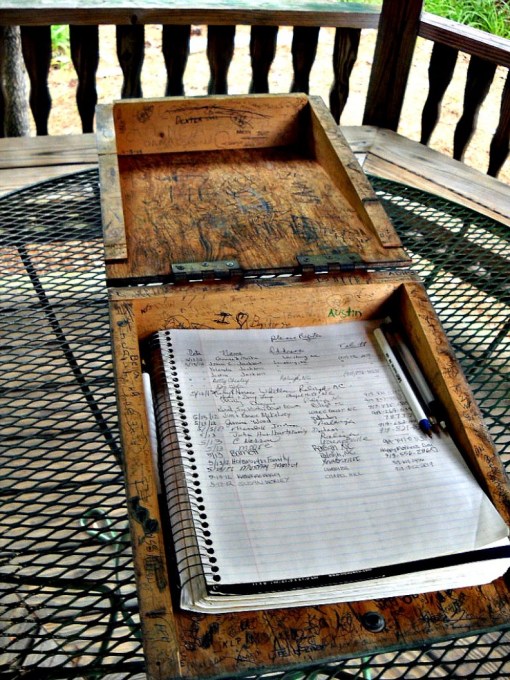
All that the De Harts ask of visitors is that they sign this guest book and refrain from carrying firearms, smoking, or littering.
A May 12th article in the Raleigh News & Observer inspired a Mother’s Day trip to Franklin County with my daughters to explore De Hart Botanical Gardens. The gardens are on over 90 acres of woodlands belonging to a retired Louisburg College professor and open to all. Developing the gardens over the course of five decades has been a labor of love and one that, due to the professor’s generosity, is available for everyone to enjoy.
We drove to Louisburg in hopes that its charms might win us over but a small town on a Sunday afternoon is pretty much a ghost town so we gave up on any expectation of finding a locally owned restaurant for a late lunch. We did spot Franklin County’s Republican headquarters in downtown Louisburg and a hand drawn sign in the window that proclaimed “Socialism is trickle up poverty.” If we couldn’t find actual food, at least that statement gave me food for thought.
Leaving Louisburg behind, we settled on having our Mother’s Day lunch at Carolina Ale House, a chain restaurant along the highway. It felt like a fitting end to our somewhat depressing Franklin County excursion, a trip that was salvaged only by knowing there are people like Allen de Hart managing to preserve some of our state’s natural beauty amidst the ugliness of commercialization and sprawl.
May 13, 2012 – County #3 – Franklin
The Quest is Born
It was the long Easter weekend, the weather was pretty, and I was looking for something different to do. I love exploring roads I’ve never traveled so I proposed a day trip to my daughters. Fortunately for me, they were both up for an adventure. I thought of Raven Rock State Park because it’s close enough to home to be a reasonable drive and has the added benefit of being a nice spot to walk on a spring day. Even better, the park is not too far from Wilber’s, Goldsboro’s legendary barbecue restaurant. It seemed a shame that neither my Tar Heel-born daughters nor their Tar Heel-bred mom had ever eaten at Wilber’s and this excursion was just the excuse we needed.
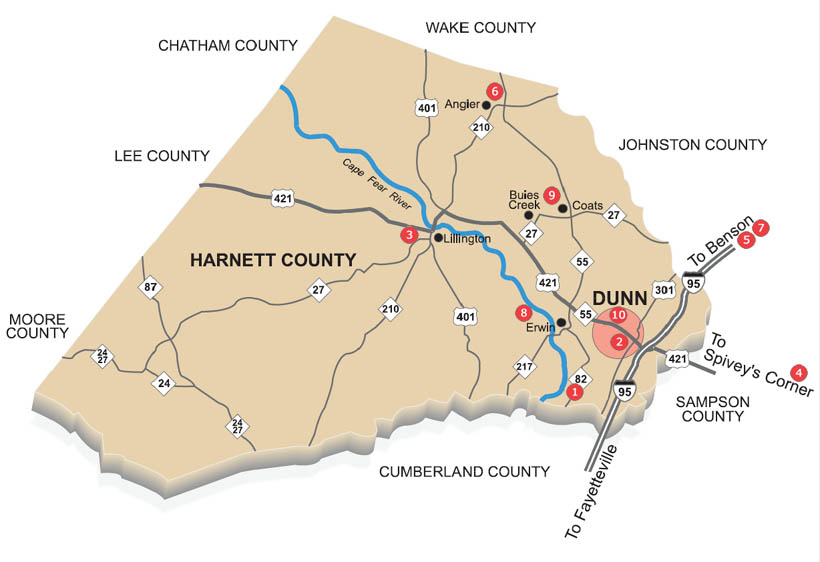
Although this was my first trip to Raven Rock, it wasn’t my first time in Harnett County. Back before I-40 was completed between Greensboro and Wilmington, the way to the beach from Chapel Hill went through Harnett County and included an infamous area near Buie’s Creek, Coats, and Angier that my husband Ron and I came to call North Carolina’s Bermuda Triangle, Neither of us is stupid and both of us can read maps but somehow, some way, we managed to get lost in that same spot every time we drove to the beach. It was so bad that we contemplated putting up a plaque at one particular crossroads there, honoring our relationship and the fact that it somehow survived countless trips through the bewildering fog of Harnett County’s own Bermuda Triangle.
All these years later, my daughters and I had the benefit of 2012 technology but mysterious forces were still at work in Harnett County, turning us around and confusing us so that we ended up on a dirt road somewhere in the middle of nowhere. Eventually we did find our way to Raven Rock State Park where we enjoyed a good walk down to the Cape Fear River – although down to the river did mean a steep ways back up to where we started. As we were leaving, we came upon a longtime Chapel Hill friend, Marianne Jones, walking the same trail – a nice surprise ending to our Raven Rock excursion.
From Raven Rock, we headed to Wayne County and Wilber’s Barbecue. I appreciated the way Wilber’s fit right into an unattractive commercial strip leading into Goldsboro. A barbecue restaurant doesn’t need to put on airs and Wilber’s wasn’t trying to. Working class people in North Carolina take a business-like approach to good food, not wasting time on banter or socializing, but instead getting right down to the serious task of eating. The silent concentration of the crowd at Wilber’s was a giveaway to just how good the barbecue was and sure enough it lived up to its legendary status.
On our return trip to Chapel Hill, I thought back to a favorite activity of my daughters when they were kids and we would spontaneously pick a road we’d never been on before and drive down it. It may not sound all that thrilling but there’s something exciting and even magical about realizing there are roads you’ve never traveled and things you’ve never seen, even though you’ve been driving right past them for years. The recollection of those fun times was my inspiration to extend the concept statewide. That’s when I set a personal goal to explore each of the 100 counties in the Tar Heel state. After all, it’s pretty unlikely I’ll ever make it to another continent or even to every state in the US but there is plenty of adventure available right here in my own home state. And so, the 100 county quest was born.
April 7, 2012. Check Harnett and Wayne counties off the list – now I’ve got 98 more to go.
The Tar Heel State
When I was an undergraduate at UNC in the early 70s, I took a class with the esteemed sociologist, John Shelton Reed. It was just the sort of class you imagine and hope that college will offer, with each day bringing something new and thought-provoking to ponder.
One day, Professor Reed told us about the results of a nationwide survey that asked Americans what state they would choose to live in if they could live anywhere in the country. To much laughter, he revealed to our class that, out of all the fifty states, North Carolina topped the list of those whose residents preferred their own state to any other. As the laughter died down though, you could see the wheels turning in people’s minds as all of us started considering how we ourselves might have answered that question. Before long, we begin admitting to one another somewhat abashedly that, when it came right down to it, we too would pick North Carolina over any other state as a place to call home.
Every state has its attributes but the truth is it’s hard to pin down anything particularly special about the state of North Carolina. Sure we’ve got mountains and beaches and barbecue and college basketball but plenty of other states have good food and even more striking vistas. College basketball, okay, no one can top us there but is that reason enough for people to never want to leave?
Tar Heel fourth graders learn the old saying in their North Carolina history class that North Carolina is a vale of humility between two mountains of conceit (those would be South Carolina and Virginia). All of us are able to appreciate the irony that North Carolinians take great pride in being renowned for humility. North Carolinians ARE a deeply proud people, it’s just hard to pin down what it is we love so much about this place.
Years ago there was a commercial with the memorable refrain “I like calling North Carolina home.” More than anything tangible you can point to that makes us like this place, that song sums up what is the closest I can come to an explanation. It’s the reason I exhale a little sigh of relief when I cross the state line and see the “Welcome to North Carolina” sign. North Carolina is home.