Girls Just Wanna Have Fun

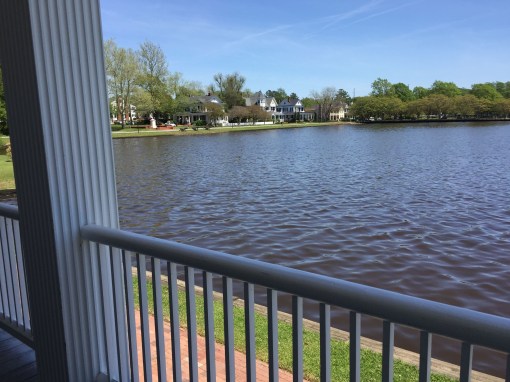
In an era when the gap between haves and have nots grows disconcertingly wider,  Roaring Gap represents a refreshing change from the in-your-face celebration of conspicuous wealth so common today. A private summer resort since the late 1800s, Roaring Gap is tucked away in the mountains of Alleghany County in a purposefully obscure spot. It says a lot about today’s world that a club for the wealthy – located in a county where more than 20% of the population lives in poverty – can invoke a kind of nostalgia for a past gilded age.

My friend Tootie invited me to come along with her close knit group of friends to enjoy a few early autumn days in the beautiful mountain region that is home to Roaring Gap. These are women who value friendship and know how to have fun together. Even when things look bleak, there’s something to be said for all of us, rich and poor, escaping to a place of great natural beauty and taking time to have fun.

September 16, 2017, County #35 – Alleghany


America the Beautiful

Annual Fourth of July celebration in tiny Faith, NC with my sister Pam! Just like every family, our country has its fair share of the good, the bad, and the ugly and, just like every family, we love and celebrate our country because of and in spite of it all…and we keep working to be our best selves.

July 4, 2017, County #34 – Rowan

Wave That Flag

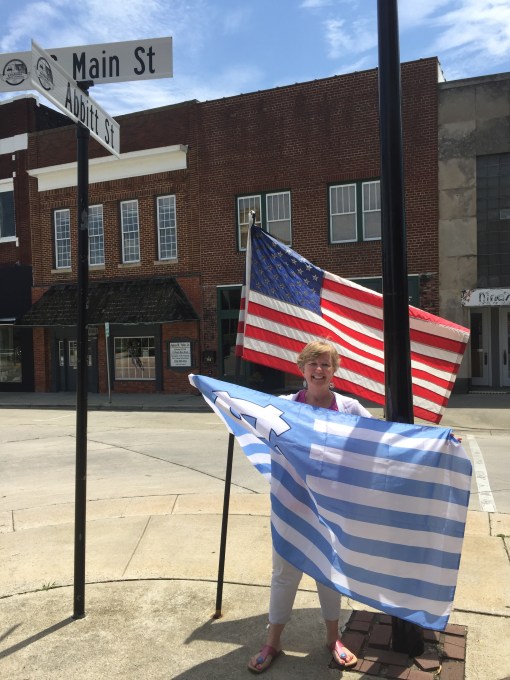
IMG_1746Having a birthday on Flag Day means flags are always flying on your special day. Every year I like to drive up Franklin Street in Chapel Hill to see the flags hung “in my honor.” When my daughters were small, I didn’t realize that they took that idea to heart and ended up feeling seriously betrayed when they got old enough to realize the flag display wasn’t actually for me.
Even with that history, Katy and Becca are still willing to indulge me. This year on June 14th, the three of us drove up to Roxboro to make sure my birthday was being properly honored in Person County. Like so many small towns in North Carolina, Roxboro has a thriving commercial strip on the outskirts of a town and a downtown that, in spite of valiant revitalization efforts, is little competition for the big chains on the highway.

I’ve lived most of my life in Orange County, just below Person. Orange County has a stark cultural divide, with the more cosmopolitan and populous towns of Chapel Hill and Carrboro in the southeastern corner while the rest of the county is more rural and traditional. Being from Chapel Hill, I’ve grown up seeing that difference from the vantage point of my little corner. Much of what I call “Northern Orange” is actually central – it’s only northern in relation to where I live.

Driving into Roxboro from Durham, I was struck by how much of a community parts of Person and Orange County create. For many people in Orange County, it’s only a few minutes to the movie theater or grocery store in Roxboro. They surely don’t think of themselves as living north of Chapel Hill; they probably spend little time thinking of Chapel Hill at all. Their community is formed across county lines.

Human beings are a self-centered bunch. Whether it’s imagining the flags are flying in your honor on your Flag Day birthday or picturing fellow county residents in relation to where you live, it’s hard to step away from ourselves and shift our perspective to how the world might look to others. Our trip to Roxboro was a good chance for me to see my world through another lens and, with the flags flying in  downtown Roxboro, a fine opportunity for me to wave my flag!

June 14, 2017, County #33 – Person

Still Waters Run Deep

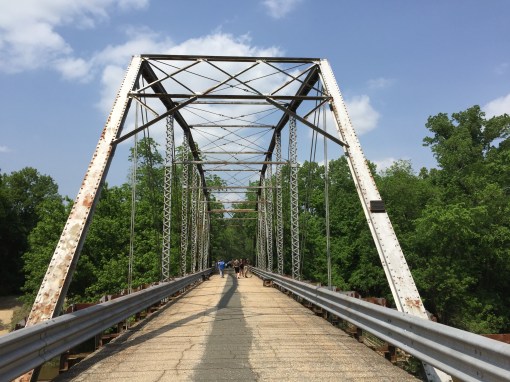
My sister Pam recently retired to Chapel Hill which means we can go on the occasional road trip together. In April, the two of us celebrated Independent Bookstore Day with trips to Hillsborough’s Purple Crow,  Flyleaf Books in Chapel Hill, McIntyre’s in Fearrington Village, and The Country Bookshop in Southern Pines. Along the way we stopped at this camelback bridge that spans the Deep River between Chatham and Lee counties. I had never heard of a camelback bridge but, looking at the picture, it’s easy to see where it gets its name. No longer used for traffic, the bridge seems now to be mostly a place where people come to fish, take pictures for special occasions like proms, and take advantage of a quiet place for reflection over the still, muddy waters of the Deep River.

April 29, 2017, County #32 – Lee


IMG_1683


Ya Got Trouble, Right Here in River City

IMG_1136When The Music Man showed up in movie theaters years ago, I was young enough that I didn’t fully understand the plot but I remember how the idea of a whole town being duped by a huckster gave me the creeps. That image was very much in my mind when my good friend Tootie and I headed to High Point to view a Donald Trump rally during the presidential campaign. We were in good spirits, expecting to have fun, more curious than anything else that so many people were showing up at Trump rallies, and wondering how anyone could be taken in by a reality tv star posing as a presidential candidate and talking like a snake oil salesman.

As it turned out, we weren’t able to get into the rally, which was held at a gated school, High Point University, an institution that has walled itself off from the community it occupies. Tootie and I drove through the working class neighborhoods that surround HPU, looking for a way in that we never found. The whole experience, the combination of the hate-filled messages on paraphernalia being sold to Trump supporters (“Lock Her Up” “Trump the Bitch”), and the depressing contrast between the country club-like university and the neighborhoods from which it was shut off, all of it left us feeling a little down.

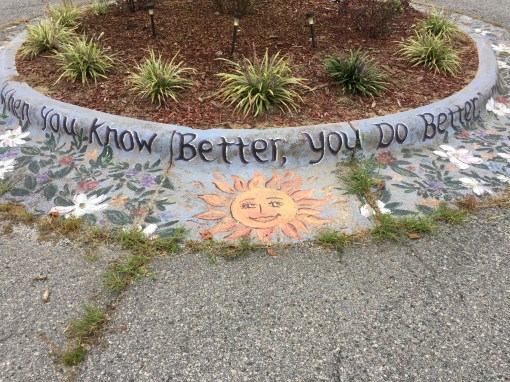
Then, backing up to the impenetrable walls of the school, we found a dead-end street whose residents had apparently taken it upon themselves to brighten their curb with decorations and a quote they attributed to Maya Angelou, the poet who lived for many years in nearby Winston-Salem.  “When you know better, you do better.”

It was a small thing and it was a big thing, finding a glimpse of beauty so unexpectedly in an unlikely spot. After the election just a few weeks after our trip, I find myself going back to that image and holding onto to the hope that, in spite of it all, we will do better.

September 20, 2016, County #31 – Guilford


Barbecue Is A Noun

Heading west to Lexington on a sunny June day with my daughter Katherine and her long-time friend Amy, the three of us reminisced about previous road trips we’ve taken together over the years. We all agreed that the most memorable of all was a trip home from a Girl Scout Jamboree at Camp Mu-Sha-Ni a few miles outside of Aberdeen, in the fall of 1991 when our country was in the midst of the Anita Hill hearings. We spent that long ago car ride mesmerized by the radio coverage of the hearings. All of us were raised in Chapel Hill and we laughed in retrospect at how typical it was of Chapel Hill kids to have been passionately following a congressional hearing when they were barely in their teens.

Twenty-five years later, Amy was home visiting from Mexico and ready to indulge in some North Carolina barbecue, giving me the perfect excuse to travel to Davidson County, a place justifiably proud of its reputation for barbecue. What better place to enjoy Lexington style barbecue than at a restaurant called Lexington Barbecue? Cheerwine, Texas Pete, hushpuppies, and some of the best barbecue I’ve ever eaten – it was worth the trip!

After lunch we drove through picturesque downtown Lexington, Davidson’s county seat, and were impressed by all the Saturday afternoon activity and busy shops. Having seen far too many deserted downtowns in small towns across our state, it does my heart good to drive through one that is thriving. From Lexington we traveled east to nearby Thomasville, a community where the furniture industry played such a major role that it’s celebrated with a giant chair in the middle of town. Sadly, downtown Thomasville was the opposite of Lexington, with deserted streets and many abandoned buildings, including furniture factories that are no longer in operation.

On the way home from Davidson County, Amy challenged Katherine and me to name all 100 counties in North Carolina. I was chagrined that we were only able to come up with 93 – and I am still convinced there is a Chocowinity County despite all the evidence to the contrary! The seven counties we overlooked were in the far eastern and western parts of the state which makes sense considering that our own hometown is smack dab in the middle.

Growing up in Chapel Hill is a special experience that creates a bond among those who have shared it, a bond that transcends generations. My hundred county quest has been an opportunity to experience North Carolina’s many different regions and to appreciate what each county has to offer. Traveling with these two Chapel Hill natives was a nice reminder that at the end of every trip, it always feels good to come home.

June 11, 2016, County #30 – Davidson

Once You Dig In

Driving northeast out of Chapel Hill on a gorgeous spring day headed towards Northampton County, the sun was out after days of gloomy skies and rain, I had a cup of coffee in hand, and Tom Petty was on Pandora singing Runnin’ Down a Dream with lyrics seemingly created for this moment. It was looking like a good day.

This would be my first solo county trip and that suited me fine. I enjoy my own company and I was looking forward to the solitude.

My first destination was a folk art creation I’d read about in the News & Observer a few days earlier, a structure of fossils and relics built over the course of many years by a fellow named Q.J. Stephenson. Mr. Stephenson, who died in 1997, spent most of his life in the woods of Northampton and Halifax counties, digging and collecting, and the result was what he called the Occoneechee Trapper’s Lodge, a building that is now for sale, along with the Stephenson home, for $32,000. I found the lodge right on the road and although I couldn’t go inside, I was able to walk all around, peer through the windows, and admire the passion, artistry, and sense of whimsy that created it.

After checking out Mr. Stephenson’s work of natural wonders, I headed east to next-door Hertford County, hoping to ride Parker’s Ferry, one of three cable ferries left in North Carolina. A cable ferry is guided by a steel cable stretched across a river, in this case the Meherrin (I pretty much lifted the previous sentence straight out of Wikipedia because I don’t understand or really care how a cable ferry works, I was just interested to see an ancient means of transportation still in use). After a long drive down a deserted, wooded road, I arrived at the ferry only to discover it was closed. No one was around but I took the chance to walk out onto the ferry and picture myself and my Honda being pulled across the scenic river, getting a pretty good sense of what it would have been like had it been up and running.

On the surface, there isn’t much to see in northeastern North Carolina. The land is flat, the population is dwindling, towns are small, and money appears to be scarce. Thankfully there have always been people like Q.J. Stephenson in this world who dig deep and show the rest of us that treasures can be found in unexpected places. It isn’t so much what you see but what you experience that gives this part of the state its flavor. Driving through counties where roads have names like Preacher Joe, the cashier at the gas station called me “baby,” and no one hesitated to pull over to the side of the road as a funeral procession passed, it was the journey itself that made the trip worthwhile just as much as where I was heading.

May 7, 2016, Counties #28 and 29 – Northampton and Hertford

Amazing Grace

GPI1Losing something like your keys or your wallet creates a sense of internal panic that never seems to be shared by the lucky folks around you who are blithely going on about their business, basking in the security of not having lost a thing.
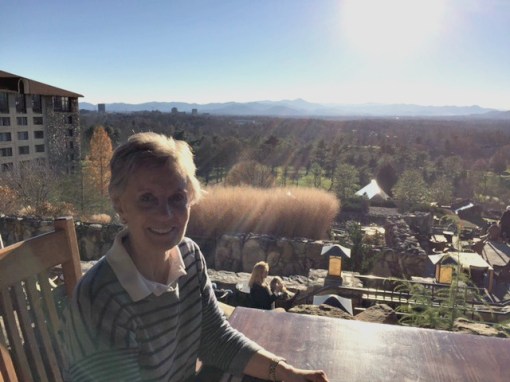
Getting ready to leave Asheville’s Grove Park Inn on the Tuesday before Thanksgiving, I suddenly realized that my coat was missing along with my car fob that I’d left in the coat pocket. This wasn’t nearly as big a concern to the helpful but busy staff members at the inn as it was to me. All I could think about though was all the cooking I had to do before Thanksgiving and how I was going to get home to start my baking without that fob to start my car.

After more than an hour of searching, just as I was ready to despair, I remembered St. Anthony, the patron saint of lost causes, and the poem a Catholic friend of mine had taught me for occasions like these: “Dear Saint Anthony, please come around, something is lost and must be found.”  No sooner had I begun reciting it than the wait person who had served my sister and me elegant drinks on the terrace the night before appeared with my coat! It felt like a true Thanksgiving miracle.

My sister Pam and I had spent the night at the elegant Grove Park Inn so that she could see the inn’s famous gingerbread house display. Pam had been wanting to see the gingerbread competition for a long time and this was the year she finally got around to it. We arrived to find the Grove Park Inn decked out in all its holiday glory. With incredible mountain views outside every window, it was a dazzling sight.

I wasn’t as interested in the gingerbread houses as I was in sharing this experience with Pam. Just three years earlier, she was on life support in the neuro-ICU at Atlanta’s Emory Hospital, in critical condition after an aneurysm burst in her brain. For many dark days, Pam’s friends and family members stood by her bedside, willing her to wake up with stories and songs. One of the things I repeated to her again and again during those long hours was that she was going to wake up and that, when she did, we would go see the gingerbread houses in Asheville.

I had plenty of time in that hospital room three years ago to reflect on loss and what it would mean for me and the rest of our family to lose Pam. Loss is one of the hardest challenges we face, whether what’s lost is car keys or basketball games or relationships or people we love. It’s no wonder that Amazing Grace is everyone’s favorite hymn. Who can forget that powerful moment when President Obama broke into song last summer at the service remembering the victims of the Charleston shooting. “I once was lost but now I’m found.” In the face of any loss, great or small, what we are all hoping for is to find what is gone and if that isn’t possible, to find grace.

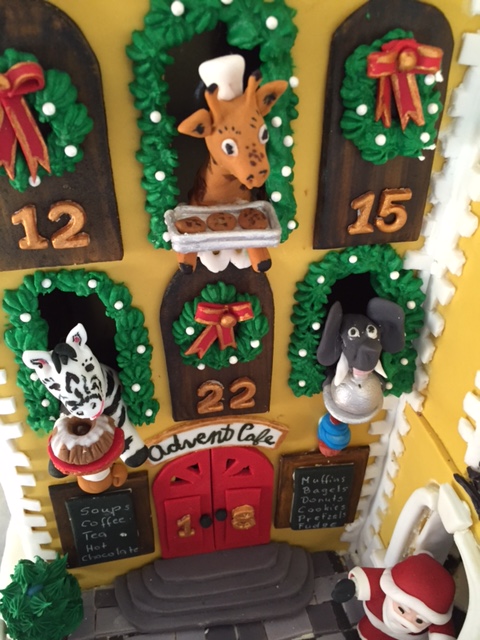
Pam miraculously recovered and woke from a coma with her brain function intact and now, here we were, in the beautiful mountains of Asheville, marveling at those gingerbread houses that I had talked to her about so many times in her hospital room. We walked through the halls of the Grove Park Inn, admiring the varied entries and the meticulous patience it must take to create them. My favorite entry in the gingerbread competition, an advent calendar created by a group of high school students, didn’t win the grand prize but the teens who built it are certainly not losers.GPI8

Loss is hard because it raises so many questions, many of which will never be answered. In these times when mass killings are becoming commonplace and the existence of our planet is threatened and Dook is winning national championships, it’s easy to despair. But even in the face of evil and danger, there are moments of grace large and small. Sisters wake up from comas and car keys are found and teen-agers spend careful hours constructing magical gingerbread structures and we remember that all is not lost and that, in this holiday season, gratitude still comes easily.

November 24, 2015, County #27 – Buncombe

The House By the Side of the Road

IMG_0604

Back in the 1890s, a New England librarian named Sam Walter Foss wrote a poem, The House By the Side of the Road, that became popular across America.  Far away in rural Caswell County, North Carolina, a boy named Henry L. Warren would learn the poem as a schoolboy in the early 1900s.

Like many young men in Caswell County at that time, Henry grew up to be a tobacco farmer.  When he finally retired from farming in 1968, Henry went out into his front yard one day and, using rocks and arrowheads from his property, was inspired to build a miniature house.  Once he started building, he never stopped. Henry’s wife reported that as long as he had a cigarette and a Coke, he was content to be outside every day adding new structures to what was to become a village he named Shangri-La.

Henry died in 1977 but Shangri-La remains in the front yard of his former home.  People driving along the road can stop and visit the village where a visitor’s journal invites passersby to leave their names and hometowns. Greeting the visitors at the entrance to Shangri-La is a sign Henry erected before his death, recalling the words of the poem he remembered from long ago, “Let me live in a house by the side of the road, and be a friend to man.”

IMG_0577

June 14, 2015, County #26 – Caswell

Main Street in Hendersonville

IMG_5547Hendersonville1Henderson County is home to Hendersonville’s walkable main street created with tourists in mind. The displays of bears up and down the street give visitors like me plenty of chances to pose for photos, the old-fashioned soda shop is the perfect place for lunch, and Becca and I lucked into spring weather that was ideal for strolling.

May 22, 2015, County #25 – Henderson