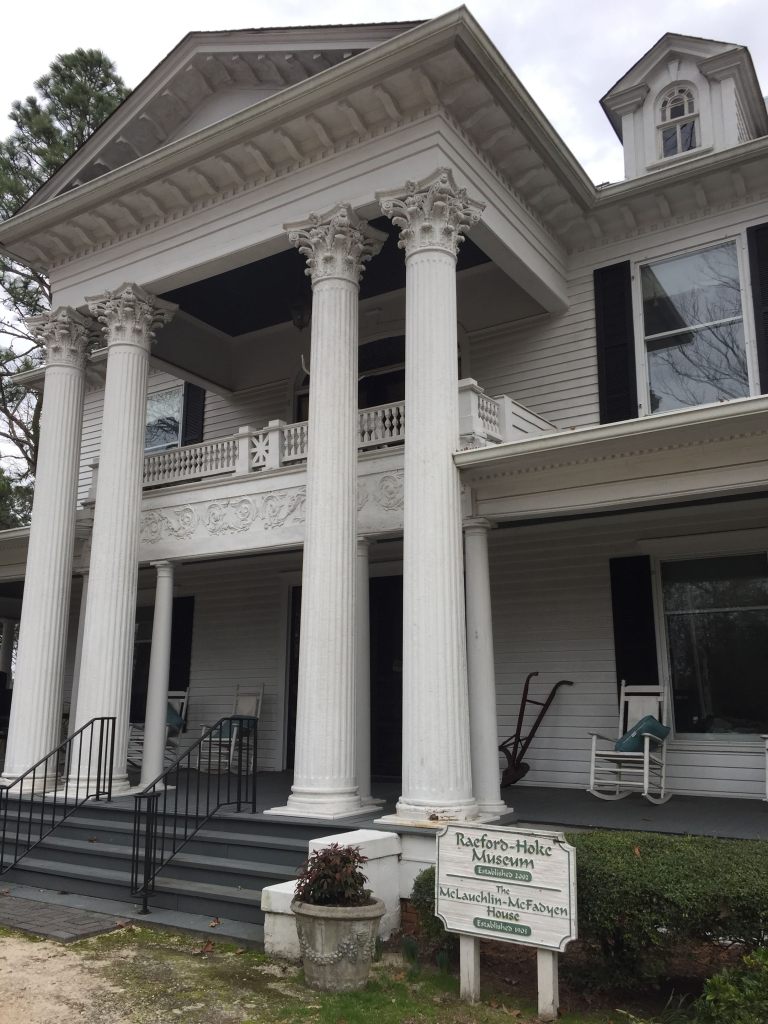
The weather was bleak and the overcast sky fit my gloomy mood as I headed to Hoke County on a chilly Saturday in January. I was listening to the UNC/Pitt game on the car radio and the Tar Heels’ poor play certainly wasn’t lifting my spirits. Perhaps, given my state of mind, I shouldn’t have picked this particular day to travel to a somewhat forsaken place where a gruesome murder was committed years before. I’ve always had an interest in family dynamics gone awry though and from what I understood, things went terribly awry for the Cameron family of Hoke County on the night before Easter Sunday in 1944. I was on my way this particular Saturday to check out the scene of a sensational crime that surprisingly little is known about.
Leon Cameron was a married farmer with three children, living in the Timberland community just outside of Raeford, when he disappeared on that fateful spring day in 1944. Most accounts of Cameron describe his family as a prominent and respected one so I was surprised to discover that his father, John A. Cameron, was sentenced to life in prison in 1912 after gunning down Raeford’s police chief. After just a year in prison, John A. Cameron escaped and lived for the next fourteen years as a prosperous businessman in Alabama before finally turning himself in to Hoke County authorities. He was returned to prison briefly but soon released on parole amid rumors that he gave the murdered police chief’s family $10,000 to request clemency.
In the meantime, Cameron’s son Leon, just two years old at the time of the police chief’s murder, had grown up without a father (although there are stories that John A. Cameron returned periodically during Leon’s childhood, staying in a secret chamber in the family’s large, brick home on Raeford’s main street). By the time Leon’s father returned home for good, a free man, Leon was almost grown and would soon marry another Hoke County local, Winnie McNeill.
Like her new husband Leon, Winnie was no stranger to childhood trauma, having lost both of her parents by the time she was seven. Winnie and her two younger brothers were raised by her deceased mother’s unmarried siblings in Raeford. One of these uncles was an undertaker, a profession that Winnie’s brother Hector would take up as well when he reached adulthood.
Winnie and Leon had been married for more than a decade when Winnie reported her husband missing, stating he had left the house three weeks before and had not been seen since. At the time, Leon and Winnie had two daughters, ages 10 and 8, and a five-year-old son. After Leon’s disappearance, Winnie went on to raise their three children as a single mom. From outward appearances, the children thrived. Their son played varsity baseball and basketball at Hoke County High, where he was named “most attractive,” went on to graduate from UNC, and later to work at Price, Waterhouse in New Jersey. The younger of the two daughters married a local boy and remained in Hoke County while the oldest girl graduated from Women’s College in Greensboro, married, and became a reading instructor at a community college in Florida.
Decades later, Winnie and Leon’s oldest daughter shared with a therapist disturbing memories of events surrounding her father’s disappearance when she was ten years old. With the therapist’s encouragement, the daughter talked with the FBI and then with a hypnotist, recovering memories along the way. She remembered her mother cleaning bloody pots and pans in the kitchen and recalled peeking into a little-used room in the family home, only to see her father’s nearly-nude body on the floor, with blood-soaked gauze wrapped around his groin. She remembered hearing noises in the night and looking outside to see her mother and mother’s brother Hector (the undertaker) carrying a large box from the porch into the backyard. Most horrific was her memory of going to use the outhouse and seeing her father’s face looking up at her, floating in a pool of excrement.
The daughter was encouraged by the FBI to confront her mother, now 69 years old, and still living in the family farmhouse. When she telephoned Winnie on December 1, 1979 and asked, “is my father still in that toilet?” her mother’s polite and understated response was one with a familiar feel to every person raised by a Southern woman. “I’ll tell you where he is after Christmas.”
The FBI was unwilling to wait for Winnie and her daughter to have that conversation and took their evidence to Hoke County sheriff Dave Barrington who obtained a warrant to search the Cameron property. Both of the Cameron daughters accompanied the authorities to help direct them to the site of the old outhouse. Their mother was at home as the digging took place and even brought the workers cookies and lemonade. Before long, a rib was discovered and soon, more and more human bones that showed evidence of having been butchered. Found with the bones was part of a wallet and the framed photograph of a woman with the name “Kate McD. King” on the back.
Winnie’s son arrived from New Jersey two days after the excavation started and discovered both his mother and her pistol missing from the family home. He enlisted the help of a friend with a small private plane to fly over the family property until he spotted his mother’s car in a clearing at the rear of the family property. He drove to the area and found his mother dead, a gunshot wound to her chest, the pistol clutched in her hand, and in her car a sealed envelope addressed to “Dave,” the Hoke County sheriff. Sheriff Barrington, called to the scene, read the suicide note and announced it was Winnie’s confession to the murder of her husband, Leon Cameron. The sheriff never divulged the remaining contents of the note.
Because of the condition of Leon’s body as the daughter remembers seeing it, the general assumption is that the crime was of a sexual nature and that Winnie suspected Leon of a liaison with the woman in the picture who was identified by the sheriff as Kate McDiarmid King. Kate King was Winnie’s aunt, one of the McDiarmid siblings who helped raise her. At the time of Leon’s death, he and Winnie were both 34 and Kate McDiarmid King was 61, twenty-seven years Leon’s senior.
The month after Winnie’s suicide, her daughter approached authorities in Cumberland County, requesting a copy of the videotape of her hypnosis session, apparently hoping to use it to share her story with the public. The videotape however had been destroyed. In a cooperative endeavor, the district attorney of Cumberland and Hoke counties, Sheriff Barrington, and Barrington’s Cumberland County counterpart stomped on and smashed the tape and then burned it in one another’s presence. Afterwards, the district attorney declared there was “absolutely nothing on the tape from a prosecutor’s perspective to justify its retention. The case was interesting, but closed.” Understatement seems to be a theme in this neck of the woods!
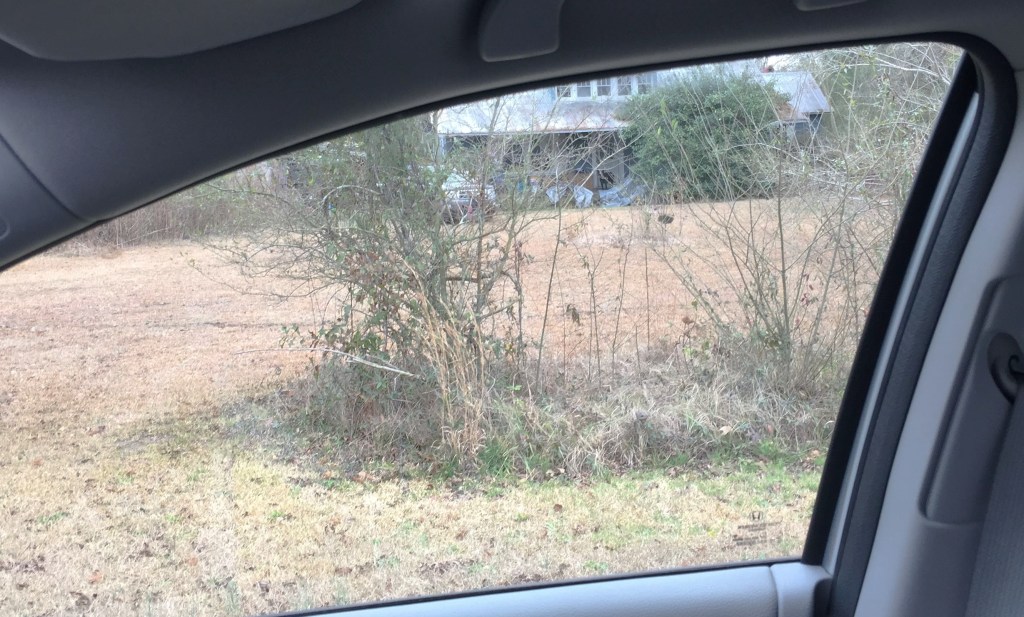
What Winnie Cameron confessed to in her suicide note and what her daughter recalled in her hypnosis session was “interesting” enough that the authorities made sure it would never be revealed. As I drove through Hoke County on that Saturday in January, almost exactly 40 years after Leon Cameron’s bones were unearthed, it was easy to believe that this was a place that would give up its secrets reluctantly. The Camerons’ former farmhouse had an unwelcoming enough look that I chose to take a photograph of it through my car window rather than get out and walk around. Less than a mile from the family homestead, I drove past the pleasant brick home of the younger of the two Cameron sisters, now in her eighties, where a no-nonsense fence and gated driveway didn’t exactly shout “please drop on in.” I stopped by the office of the Hoke County Historical Society in Raeford but it was locked tight, although it is advertised to be open on Saturday afternoons. I chatted with another person who was waiting there in hopes of getting in to do some research, a Hoke County native who had lived there all his life. He had never heard of the murder of Leon Cameron.
Lee Smith’s wonderful 1985 novel, Family Linen, is loosely based on the macabre tale of Winnie and Leon Cameron and the 2020 Netflix series, Outer Banks, has a minor storyline that mirrors it as well. Apart from these fictional works, little has been written or told about the grisly murder of Leon Cameron. Any hopes I might have had of finding out more by driving to Hoke County came to naught. Whether it’s skeletons in the closet or bones beneath the outhouse, Hoke County appears to be a place that guards its secrets well, allowing them to remain buried and hidden for years or even into eternity.
January 18, 2020, County #42 – Hoke


Love this, I had no idea!
This is a great read. My family has lived here for 20 plus years. We have had a house full of love and have never seen or heard anything creepy. We have wondered for years where the outhouse was. We have our suspensions.We just read your article to our daughter who is 13 and she is rightly freaked out as she had never heard the story. We learned a few things from your research. Thanks again.
PS that big black dog on the porch was Shadow … He is very protective…
Tim
So glad you found this story and shared your reactions, Tim! I wanted it to be respectful because it is a family’s tragedy but it is hard not to be fascinated by it all. Also, now that I know about Shadow being so protective, I’m glad I didn’t walk up to the porch unannounced. 🙂
My husband is named after John C Cameron, his grandmother’s brother, and Leon Cameron was his second cousin. I already knew both stories, and was searching for information to send to my stepson when I found your post. What details! I could hardly stop laughing when I read that Winnie actually brought cookies and lemonade to the workers digging up her husband’s bones. Thanks so much for this info and the photo. I’ll read Lee Smith’s book and search for the related episode on Outer Banks.
So glad you found this! Your husband’s family has quite a history and that’s an understatement!
Indeed! His family history is much more interesting than mine.
I first read this story, upon Winnie’s suicide, in the Raleigh News & Observer and have been intrigued by it ever since. Yours is the most descriptive account I’ve read. Thanks for putting it together. Leon and Winnie are buried in the Raeford Cemetery (Find-a-Grave) but do not seem to be buried together. There is a 1979 newspaper article entitled “Outhouse Murder” from the Fayetteville Daily News illustrated in Leon’s Find-a-Grave page listed under Edward Leon Cameron. The article may have been reprinted in the News and Observer and was the one I read.
Reading this from country of Georgia. Crazy story. Found a short version on reddit and there was link that led me to this article.